World Stroke Day has just passed, and it is a good moment to say something plainly: for many stroke survivors in Dubai, rehabilitation stops too early. Hospital rehabilitation is often excellent but time-limited. Once someone can walk and manage at home, the intensive support tends to fall away, even though the brain is still recovering and still capable of more.
If you or a family member are looking for stroke rehabilitation in Dubai, this article sets out what a complete programme should include, so you can judge any provider, including us, against it.
Why “complete” matters
A stroke affects far more than movement. Depending on where in the brain it occurred, it can affect language, memory, attention, mood, swallowing, vision, balance and energy. A programme that treats only the arm or only the leg leaves the rest unaddressed. Recovery is fastest and furthest when every affected system is worked on, together, by a team that talks to each other.
In Dubai there is a specific reason this matters. Hospital rehabilitation after stroke is often limited by the number of physiotherapy sessions an insurance plan will approve, and once those are used the survivor is frequently discharged to home with a printed exercise sheet. Families, many of them expatriates without relatives nearby, are left to coordinate physiotherapy, speech therapy and follow-up across several providers. A single coordinated programme removes that burden.
The eight components of a complete stroke rehabilitation programme
1. A thorough baseline assessment
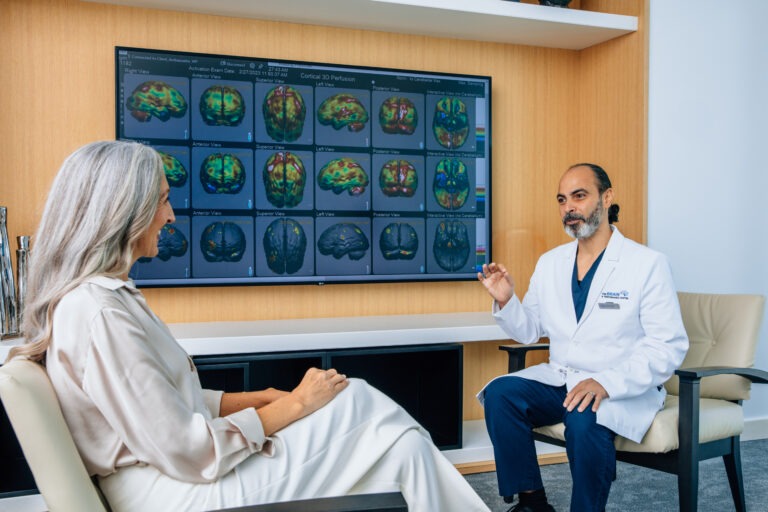
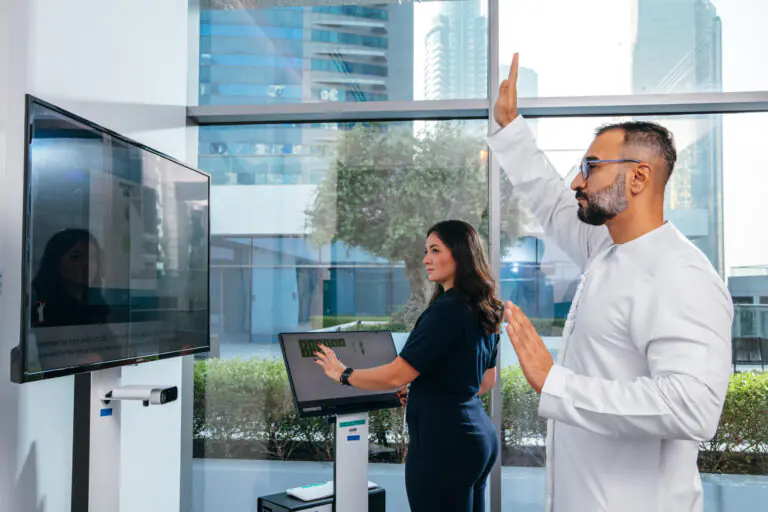
Before treatment starts, you should be assessed properly: neurological examination, brain imaging where needed, cognitive performance testing, physical and functional testing, and a review of your cardiovascular risk. Without a baseline, no one can honestly tell you whether you are improving. This is what our adult assessment is designed to do.
2. Physiotherapy
Restoring strength, balance, coordination and gait. Good post-stroke physiotherapy is task-focused, progressive and intensive. It should also address fatigue management and fall prevention.
3. Occupational therapy
Relearning the practical skills of daily life: dressing, cooking, writing, using a phone, returning to work. Occupational therapy bridges the gap between “better on paper” and “better in life”.
4. Speech and language therapy
For difficulties with speaking, understanding, reading, writing or swallowing. These problems are common, often improve substantially with therapy and are frequently under-treated.
5. Cognitive rehabilitation
Structured training for attention, memory, processing speed and executive function. Post-stroke cognitive impairment affects a large proportion of survivors and is one of the strongest predictors of whether someone returns to independent living and work.
6. Hyperbaric oxygen therapy
HBOT increases the oxygen available to brain tissue that survived the stroke but is functioning below capacity because of reduced blood flow. Clinical research, including randomised trials in patients at the chronic stage, has shown improvements in neurological function and quality of life when HBOT is delivered as a structured course. At our centre it is combined with the therapies above, not offered instead of them.
7. Nutrition and metabolic support
A dietitian-led review of vascular risk, weight, blood sugar and the nutritional needs of recovery. This is about preventing the next stroke as much as recovering from the last one.
8. Psychological support
Depression and anxiety after stroke are common and they slow recovery. A good programme recognises this and provides support, for the survivor and often for the family. Our guide on how to help a stroke survivor recover has practical steps for families.
Questions to ask any stroke rehabilitation provider in Dubai
- Which of the eight components above do you provide, and which would I need to find elsewhere?
- Who coordinates my care across the different therapists?
- How do you measure progress, and how often will you show me the results?
- How intensive is the programme, in hours per week?
- Do you treat people who are months or years past their stroke?
- What is the role of the physician in my programme?
If you would like to put those questions to us directly, book a conversation with our stroke recovery team.
How the programme works at The Brain & Performance Centre
Our stroke recovery programme in Jumeirah Lakes Towers brings these components together under one roof, coordinated by a physician, and built around a structured course of hyperbaric oxygen therapy delivered daily in medical-grade multiplace chambers. Every client is tested before and after the programme, and those results are reviewed with you and your family.
We treat adults and children, and we treat people at every stage after stroke, including those who have been told that recovery has stopped. If you are earlier in recovery, our article on recovery after a mild stroke explains what the first weeks and months look like.
Book a consultation and a tour of the centre to discuss your situation and see how the programme works. Families are welcome. Call 800-2848 from within the UAE.
Frequently asked questions
How long is stroke rehabilitation?
Our programme runs for three months, with daily hyperbaric sessions and the therapy content adjusted to the individual. Recovery can continue beyond that with the right support.
Is it too late for rehabilitation if the stroke was years ago?
No. Research has shown measurable improvement in people treated years after their stroke. The brain’s capacity to change does not switch off at a fixed date.
Can family members be involved?
Yes, and we encourage it. Family understanding and support is one of the strongest predictors of a good outcome.
Do you offer stroke rehabilitation for children?
Yes. Our paediatric stroke recovery programme is designed specifically for children and young people.