Transformative Stroke Treatment Programme
Recovering After a Stroke - Is it Ever Too Late?
Recovery after a stroke is a unique journey for each survivor, and timelines can vary greatly—it’s common and understandable to feel discouraged along the way. Stroke recovery is not always linear and can involve ups and downs. But if it’s been months or even years after the stroke incident and your progress still isn’t where you want to be, you can still have hope.
Backed by a diverse medical staff and over a decade of leading research, The Brain & Performance Centre – A DP World Company offers a unique and comprehensive post-stroke rehabilitation program using the world’s most advanced hyperbaric oxygen program. This program has rehabilitated individuals’ cognitive and physical capabilities, even years after a stroke.
The Brain & Performance Programme Helps Heal Brain and Body
Backed by over a decade of research, our personalized & comprehensive programme combines cognitive and physical training with unique Hyperbaric Oxygen Therapy to treat the body and brain after a stroke.
HBOT involves breathing 100% pure oxygen in a special room known as a HBOT suite. During the sessions, we implement oxygen fluctuations, which trigger the body’s self-regeneration mechanism.
Benefits of the programme include increased cognitive, physical and cellular functioning. Want to learn more?
How it works
The Brain & Performance Programme has delivered clinical positive results for stroke treatment based on over a decade of research. Our programme includes:
The Brain & Performance Programme
A structured, data-driven programme designed to optimise cognitive and physical performance.
The Brain & Performance Programme integrates advanced hyperbaric oxygen therapy with comprehensive cognitive assessments, targeted physical conditioning, and lifestyle interventions, each component grounded in rigorous scientific evidence and delivered to medical-grade standards. Every aspect of the programme, from diagnostics to treatment and monitoring, is evidence-based, clinically validated, and overseen by medical professionals.
Throughout the programme, key biological and neurological markers are continuously tracked, enabling precise, personalised optimisation of mental clarity, stamina, recovery, and overall brain health.
Assessment
A three-day comprehensive medical, physical and cognitive assessment conducted by certified medical professionals including physicians, neuropsychologists, physiotherapists, dietitians and nurses.
Treatment
An intensive 12-week protocol of HBOT sessions, enhanced by training for your brain and body, and a personalized nutritional, cognitive & physical training programme.
Post Assessment
We repeat the tests from the initial assessment to measure results objectively and make recommendations for your ongoing progress.
Follow Up
We continue to keep track of your health and progress after the treatment through our remote monitoring platform, as well as at in-person checkups.
Program Benefits
Brain Blood Flow and Connectivity
Hyperbaric treatment improves cerebral blood flow, supports the growth of new neurons, and enhances the brain’s ability to communicate efficiently across key networks involved in cognitive performance.
Cognitive Performance and Mood
Clients often experience clearer thinking, quicker information processing, stronger executive functions and improved memory, alongside a more stable mood, better attention control and more restorative sleep.
Strength, Energy and
Mobility
The programme helps increase physical stamina, improve coordination and support stronger movement patterns, enabling clients to perform daily activities with greater energy, stability and confidence.
Recovery, Pain and Physical Health
Reduced inflammation, improved skin quality and enhanced recovery are commonly reported. The programme may also support hormonal balance and sexual performance by improving circulation and promoting tissue repair.
Immune and Regenerative Support
Hyperbaric therapy strengthens immune responses and encourages stem cell activity, helping the body repair more effectively and maintain healthier tissue function over the course of the programme.
Cellular Ageing & Mitochondrial Health
The treatment supports healthier ageing by helping maintain telomere length, reducing senescent cells and enhancing mitochondrial efficiency, all of which contribute to better long-term cellular performance.
Our Success Stories
Real results from real people. These success stories share genuine experiences of how our evidence-based programmes have helped improve their lives.
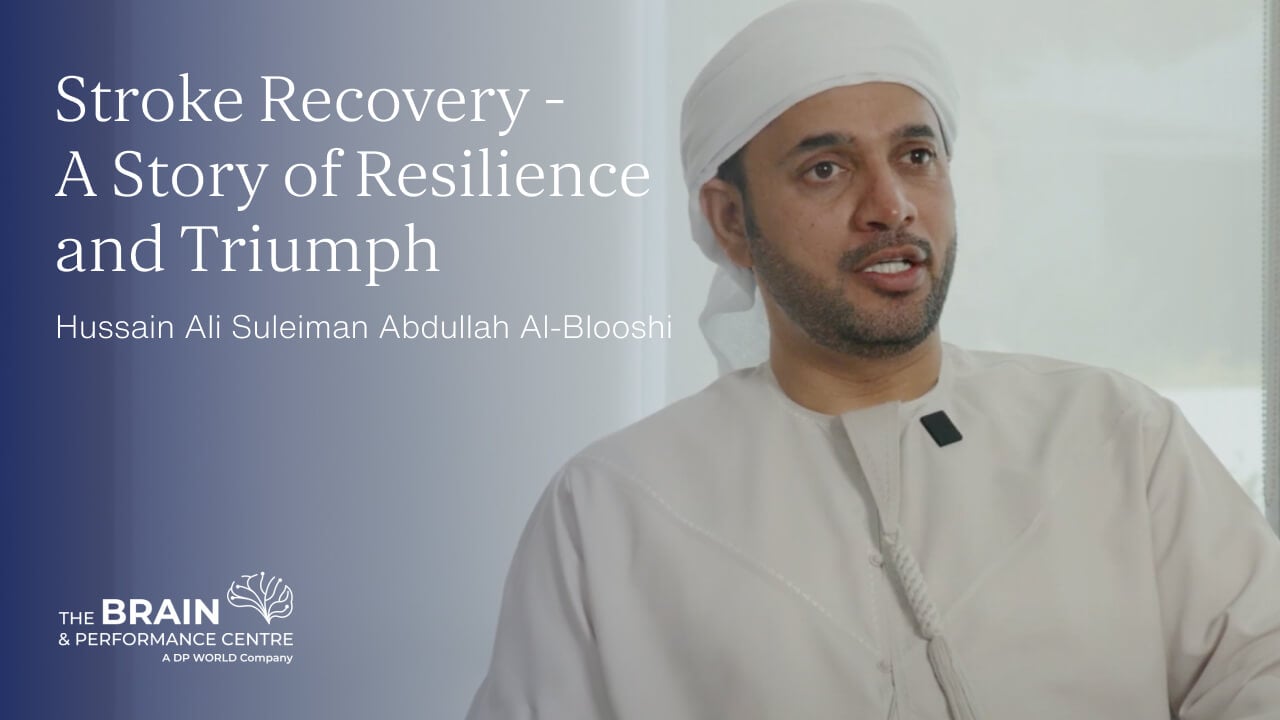
Hussain Al Blooshi
Stroke Recovery And Triumph
Meet Dr. Semer Wang, Medical Director at The Brain & Performance Centre - A DP World Company
Dr. Wang is the Medical Director of The Brain & Performance Centre – A DP World Company, a certified family medicine and hyperbaric physician. Dr. Wang has been practicing hyperbaric and diving medicine for more than twenty years.
“Finding a path forward to a better life can feel impossible after a stroke. If you are a caregiver to a stroke survivor, we encourage you to be patient with each step. Every individual is different, and thus, timelines to recovery will be unique”.
Contact us to learn if you’re a candidate for the Brain & Performance Programme.
Stroke Research and HBOT Stroke Treatment: Clear & Proven Research
Recent clinical studies at the Shamir Medical Center have evaluated the effects of HBOT on patients suffering from neurological issues caused by stroke. In the latest research headed by Dr. Amir Hadanny and Dr. Shai Efrati, the team evaluated the effects of HBOT on stroke patients. An analysis was done on 162 patients who were treated with HBOT for chronic stroke (three or more months after the incident).
HBOT led to significant improvements in all cognitive domains, even in the late chronic stage. The following clinical improvements were achieved regardless of the type of stroke or where it occurred in the brain:
Hyperbaric oxygen therapy improves neurocognitive functions of post-stroke patients – a retrospective analysis. The research reports HBOT can drive improvements in “cognitive domains” even for those in the “late chronic stage” of their post-stroke journey.
Hyperbaric Oxygen Induces Late Neuroplasticity in Post Stroke Patients – Randomized, Prospective Trial Those who participated in HBOT sessions experienced “neurological improvements” and boosts in quality of life.
Hyperbaric Oxygen Induces Late Neuroplasticity in Post Stroke Patients – Randomized, Prospective Trial
Efrati, S., G. Fishlev, Y. Bechor, O. Volkov, J. Bergan, K. Kliakhandler, I. Kamiager, N. Gal, M. Friedman, E. Ben-Jacob, and H. Golan.
- PLoS One 8
- no. 1 (2013): e53716
Hyperbaric oxygen therapy improves neurocognitive functions of post-stroke patients – a retrospective analysis
Amir Hadanny, Mor Rittblat, Mor Bitterman, Ido May-Raz, Gil Suzin, Rahav Boussi-Gross, Yonatan Zemel, Yair Bechor, Merav Catalogna, Shai Efrati
- Restor Neurol Neurosci
- 2020; 38(1):93-107
If you or a loved one has suffered a stroke we may be able to help, contact us today.
Undertsanding Stroke
A stroke happens when the blood supply to a part of the brain is cut off because of a blockage of a blood vessel or bleeding. This stops the brain from getting the oxygen it needs, which can lead to brain injury. Depending on the area of stroke in the brain, the symptoms can vary and its impact on daily living varies.
According to the World Health Organization, one in four people runs the risk of having a stroke in their lifetime. In the UAE, about 25 per cent of adults have hypertension, which puts our population at greater risk of having a stroke and almost 50% of strokes occur in people who are in there 50. Stroke is the leading cause of disability and the third leading cause of death. It has never been more crucial to have the most innovative technology available for treating patients.
Ischemic Strokes vs Hemorrhagic Strokes
Ischemic and hemorrhagic strokes are the two main types of strokes. While they have some of the same symptoms, they also possess unique traits.
Understanding their respective symptoms can help you learn more about your body, as well as hemorrhagic and ischemic stroke treatment options.
Rehabilitation Options, Including Hyperbaric Oxygen Therapy (HBOT), for Stroke Patients
Rehabilitation options after a stroke include speech, physical, and occupational therapy. Learn what each entails, along with the groundbreaking therapeutic approach of HBOT provided at The Brain & Performance Centre.
Hyperbaric Oxygen Therapy (HBOT) Options for Stroke Recovery
Several studies have proven the benefits of using a specific HBOT protocol in post-stroke recovery. Learn how soon after a stroke HBOT can be administered, how long it takes to see results, and what our programme looks like.
HBOT’s Impact on Stroke Treatment
When life feels impossibly hard after a stroke, rest assured not all is lost. The The Brain & Performance Programme leans on advanced tools and therapies for stroke rehabilitation. Based on research-backed protocols, our HBOT process has helped clients achieve improvements even years after their stroke event.
Enhance Your Post-Stroke Journey
The brain is a powerful organ that can learn at any age. The more we take time to engage our brains, the more we can experience cognitive improvement. Our medical team provides brain exercises for stroke survivors. Dive into these activities during your break time.
These exercises will include:
– Cognitive Training
– Cognitive Rehabilitation
– Engaging Cognitive Tasks
– Targeted Cognitive Training
10 Signs and Symptoms of a Mild Stroke
It’s possible to have a stroke and not even know it happened or remember it happening. Though they might be called “mild,” these strokes still damage brain cells and tissues. Thus, we strongly urge you to learn about the key signs and symptoms of a mild stroke.
- Motor weakness: face, arm, leg, combination, usually one sided
- Slurred speech or difficulty speaking
- Difficulty understanding
- Deficits in sensation: face, arm, hand, leg
- Transient or complete vision loss in one eye (usually painless)
- Loss of parts of the visual field
- Double vision (occurring with other symptoms)
- Unsteady gait
- Dizziness or vertigo
- Difficulty swallowing