People stop peptides for all sorts of reasons. The course ended. The cost added up. The side effects were not worth it. The supply became unreliable or the legality became a worry. A sports body prohibited them. A doctor advised against continuing. Or, quite often, the results plateaued and the daily injections stopped feeling justified.
Whatever the reason, stopping raises a practical question: what now? The goals that led you to peptides, faster healing, better recovery, sharper thinking, more energy, a slower ageing process, have not gone away. This article explains what happens in the body when peptide treatment ends, what to check before you do anything else, and why hyperbaric oxygen therapy is a logical next step.
Who this is for
We see a recognisable set of people in this position at our centre in Jumeirah Lakes Towers.
- The athlete or serious amateur who used healing or growth hormone peptides for an injury or a training block and now needs to be clean for testing, or simply wants to stay on the right side of the rules
- The executive who was introduced to a “longevity stack” and has decided the daily injections, the sourcing and the uncertainty are not worth it
- The person finishing a GLP-1 course who has lost weight and is now worried, with reason, about what happens next
- The person with a stalled injury who tried BPC-157 or TB-500 bought online, saw little change, and wants something with evidence behind it
- The person who has simply lost confidence in what was in the vial
If you recognise yourself, the rest of this article is for you.
What happens when peptide treatment stops
Peptides work by adding a signal from outside. When the signal stops, the body returns to running on its own signalling, and the transition is rarely seamless.
Growth hormone secretagogues such as CJC-1295, ipamorelin and the GHRP family stimulate the release of growth hormone. When they stop, growth hormone and IGF-1 levels return to baseline. Users commonly report a dip in recovery, sleep quality and energy in the weeks that follow, and changes in body composition can reverse. The body’s own growth hormone rhythm generally recovers, but it takes time, and the recovery is slower in people who used them for longer.
Healing peptides such as BPC-157 and TB-500 are used in the hope of accelerating tissue repair. When they stop, any support they were providing ends and the injury is back to relying on your own repair capacity. If that capacity was the problem in the first place, the injury may stall again.
GLP-1 medications such as semaglutide reduce appetite and slow digestion. When they stop, appetite returns and weight regain is common. A 2022 extension study found that participants regained around two-thirds of their lost weight within a year of stopping. This is not a failure of willpower. It is pharmacology, and it is why stopping a GLP-1 medication should be planned with a physician rather than simply allowed to happen.
Cognitive peptides such as Semax and Selank have short-lived effects, and users often notice the absence of the effect more than any withdrawal.
All peptides, approved or not, leave the body’s own regulatory systems to readjust. That readjustment takes time, and it is the window in which people most often feel worse before they feel better.
There is a further consideration for anyone who used unapproved products. You may not know exactly what you were taking, at what dose, or what else was in the vial. A medical check is worth doing for that reason alone. Book a post-peptide check with our clinical team and bring whatever packaging and records you have.
Start with a medical check
Our recommendation for anyone stopping peptides, particularly unapproved ones, is a consultation and blood panel before anything else. At The Clinic by The Brain & Performance Centre, our DHA-licensed general practice on the same site, that means:
- A consultant physician review of what you were taking, for how long, and why
- Blood work covering fasting glucose and insulin, liver and kidney function, lipids, inflammatory markers, hormones and any additional tests our physicians deem appropriate
- Blood pressure and cardiovascular measures
- For anyone with ongoing symptoms of brain fog, fatigue or poor recovery, cognitive performance testing to establish an objective measure of your current brain function
For most people this is reassuring. Where something is out of range, it is far better to know now than to discover it later, and it shapes what comes next.
Why HBOT is a logical next step
Hyperbaric oxygen therapy approaches the same goals from the opposite direction. Rather than adding an external messenger, it creates the conditions for your body to produce its own.
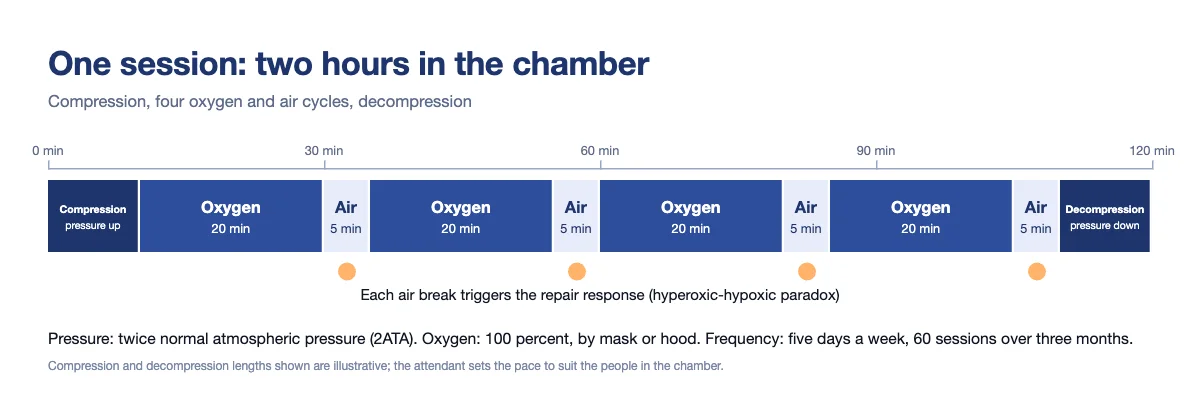
Inside the chamber you breathe 100 percent oxygen at twice normal atmospheric pressure (2ATA), in cycles of 20 minutes on oxygen and five minutes on chamber air, for two hours a session, five days a week. The high oxygen delivers far more to tissue than breathing under normal pressure can. The repeated drop back to normal levels during the air breaks is interpreted by cells as a shortage (hypoxia), and they respond by switching on the body’s regenerative machinery. This is the hyperoxic-hypoxic paradox.
The effects have been measured in human studies:
- Mobilisation of stem cells from the bone marrow
- Release of growth factors and the formation of new blood vessels
- Improved mitochondrial function, which is the cellular basis of energy
- Reduced inflammation
- In the brain, increased neuroplasticity and improved blood flow
- In a 2020 study of healthy older adults, changes in biological markers of ageing including telomere length
In other words, HBOT strengthens the systems that peptides were standing in for. It is a way of handing the work back to your own body, with the body better equipped to do it.
Three further points matter to people in this position.
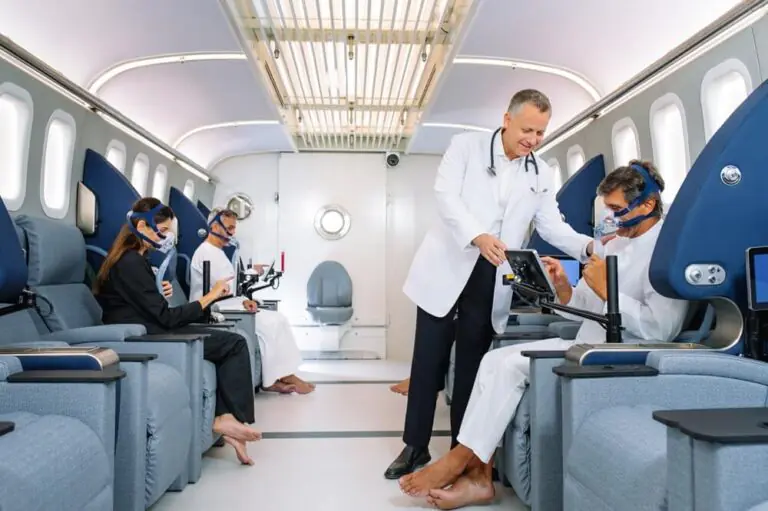
There is nothing to source and nothing to inject. The treatment is delivered at our centre by our team, in medical-grade multiplace hyperbaric chambers with a trained attendant beside you.
It is permitted in sport. Hyperbaric oxygen therapy is not a prohibited method under the World Anti-Doping Code, which makes it a genuine option for athletes who have had to stop peptides for testing reasons.
It is measured. You are assessed before the programme and again at the end. The comparison tells you what changed.
What HBOT can support after peptides
Injury recovery and tissue healing. The reason many people tried healing peptides in the first place. HBOT’s effects on blood vessel growth, inflammation and tissue oxygenation are the basis of its long-established use in wound healing and surgical recovery, and of its use by athletes for musculoskeletal injuries.
Energy, sleep and recovery from training. The dip that often follows stopping growth hormone secretagogues is, in part, a recovery deficit. HBOT addresses recovery at the cellular level, and improved sleep is one of the most consistently reported effects in the first weeks of a programme.
Cognitive performance. Trials in healthy adults and in adults with mild cognitive impairment (MCI) have shown improvements in attention, processing speed and memory after a full course. For people who used cognitive peptides, this is the evidence-based route to the same goal.
Healthy ageing. The 2020 findings on ageing biomarkers are the foundation of our reverse ageing programme.
Metabolic health. For people coming off GLP-1 medication, HBOT is not a weight loss treatment and will not replace the appetite effect of the medication. What it can do is sit inside our supervised metabolic weight loss programme, with dietitian-led support and physician oversight, so that the transition off medication is managed rather than abrupt.
The programme
The neurological and performance protocol is 60 sessions over three months, two hours a session, five days a week, at our centre in JLT. Most clients book a consistent daily slot and work around it. Sessions are seated, the chambers are spacious and well lit, and you can read or listen to music. You will also spend time on your bespoke cognitive training programme, loaded onto your personal tablet computer.
Before the programme you complete a baseline assessment: cognitive performance testing, physiological testing and, where indicated, brain imaging and blood markers. At the end, the same tests are repeated. Your physician reviews the results with you.
What happens next is individual. Some clients repeat the programme, yearly or more often, to stay in peak shape, and some continue with one or two maintenance sessions a week. Your physician will advise based on your results.
What this looks like in Dubai
Dubai has one of the highest concentrations of gyms, longevity clinics and performance-focused professionals anywhere, and one of the easiest environments in which to obtain unregulated products. It also has a regulator, the Dubai Health Authority, that licenses facilities and clinicians and takes a clear position on unapproved medicines. Our centre and The Clinic are DHA-licensed, our hyperbaric facility is UHMS-accredited, the first in the Middle East, and we have delivered tens of thousands of hyperbaric treatments. That combination is what people stopping peptides usually say they were looking for: something regulated, something measured and something a doctor is responsible for.
If you are still deciding between the two approaches, our article on HBOT vs peptides compares the evidence side by side.
Start with the blood panel
The first step costs you a morning and tells you where you stand. From there, your physician can advise whether our programme is appropriate, and which one.
Book a post-peptide consultation and blood panel at The Clinic, or call 800-2848 from within the UAE. A tour of the chambers is included if you want it.
Frequently asked questions
How soon after stopping peptides can I start HBOT?
There is no required gap. Most people can begin once they have had a consultation and medical screening. Tell your physician exactly what you were taking and when you stopped.
Can I do HBOT while still using peptides?
Disclose everything at your consultation. HBOT has no known interaction with approved peptide medications, but your physician needs the full picture, and unapproved products are an unknown quantity.
Will HBOT stop me regaining weight after GLP-1 medication?
No. Weight regain after stopping GLP-1 medication is driven by appetite returning, and HBOT does not change that. A supervised metabolic programme does, and HBOT can support it.
Is HBOT safe if I have used unregulated peptides?
The screening before treatment exists for exactly this reason. Blood work and a physician review identify anything that needs to be addressed first.
Will HBOT give me the same results as peptides?
It works differently, and the results depend on what you were using peptides for. For recovery, healing, cognition and ageing, the human evidence for HBOT is stronger than for research peptides, and the results are measured rather than assumed.
Do I need a referral?
No. You can book directly with The Clinic or with our programme team.