Peptides have gone from a bodybuilding forum topic to a mainstream conversation in a very short time. Search interest in the UAE has more than quadrupled in a year. In Dubai the conversation runs through gyms in Business Bay, longevity clinics on Jumeirah Beach Road, WhatsApp groups and, increasingly, our own consultation room. People are asking about peptides for injury recovery, for energy and sleep, for cognitive performance, for weight loss and for slowing the ageing process. And they are asking us a specific question: how do peptides compare with hyperbaric oxygen therapy, and which should I choose?
This article gives a straight answer. It is written for someone who has done some reading, is weighing up their options and wants the evidence rather than the marketing.
A quick note first, because it comes up. If you arrived here searching for BPC-157, the healing peptide, you have found a different BPC. We are The Brain & Performance Centre, a DP World company in Jumeirah Lakes Towers. The coincidence is a happy one, because the goals people have when they search for that peptide are exactly the goals our programme is built for.
What peptides are
Peptides are short chains of amino acids. Your body produces thousands of them, and they act as messengers, telling cells to do things: release a hormone, start a repair process, regulate appetite, signal that it is time to sleep. Some peptides are established, approved medicines with decades of use. Insulin is a peptide. So are the GLP-1 medications used for diabetes and weight management, which are prescribed by physicians and backed by large clinical trials.
Then there is a much larger and much less regulated category, often sold as “research peptides”: compounds such as BPC-157, TB-500, CJC-1295, ipamorelin, GHK-Cu, epithalon and the growth hormone releasing peptides. These are the ones most people mean when they talk about peptides for recovery, performance or anti-ageing. They fall into rough groups:
- Healing and tissue repair peptides, chiefly BPC-157 and TB-500, marketed for tendon, ligament, gut and muscle injuries
- Growth hormone secretagogues, such as CJC-1295, ipamorelin and the GHRP family, which stimulate the body’s own growth hormone release and are marketed for recovery, body composition and sleep
- Cosmetic and skin peptides, such as GHK-Cu, used topically and by injection
- Longevity peptides, such as epithalon, marketed for telomere and ageing effects
- Cognitive peptides, such as Semax and Selank, marketed for focus and mood
These compounds share three characteristics that matter to anyone considering them.
The human evidence is thin. Most of the claims rest on animal studies, small trials or anecdote. BPC-157, the most searched healing peptide, has extensive rodent data and, at the time of writing, almost no controlled human trials. CJC-1295 reached early-phase human trials and no further. Epithalon’s human evidence comes largely from older studies that have not been replicated at scale.
They are largely unapproved and unregulated. Products sold online are frequently mislabelled, under-dosed or contaminated. Independent testing of research peptides bought online has repeatedly found products that do not contain what the label says. In the UAE, medicines require approval by the Ministry of Health and Prevention and must be prescribed by a licensed physician; a vial ordered from an overseas website meets neither condition.
Several are prohibited in sport. Growth hormone secretagogues have long been on the World Anti-Doping Agency prohibited list, and BPC-157 was added in 2022. For anyone competing under UAE or international federations, that is decisive.
None of this means peptides do nothing. It means that, outside a small number of approved medicines, you are experimenting on yourself with limited information and an unverified product.
What hyperbaric oxygen therapy is
Hyperbaric oxygen therapy, or HBOT, is a medical treatment in which you breathe 100 percent oxygen inside a pressurised chamber. It has been used in mainstream medicine for over half a century and is an established treatment for conditions from decompression sickness to non-healing wounds. Over the past fifteen years it has been studied intensively for its effects on the brain, on recovery and on ageing.
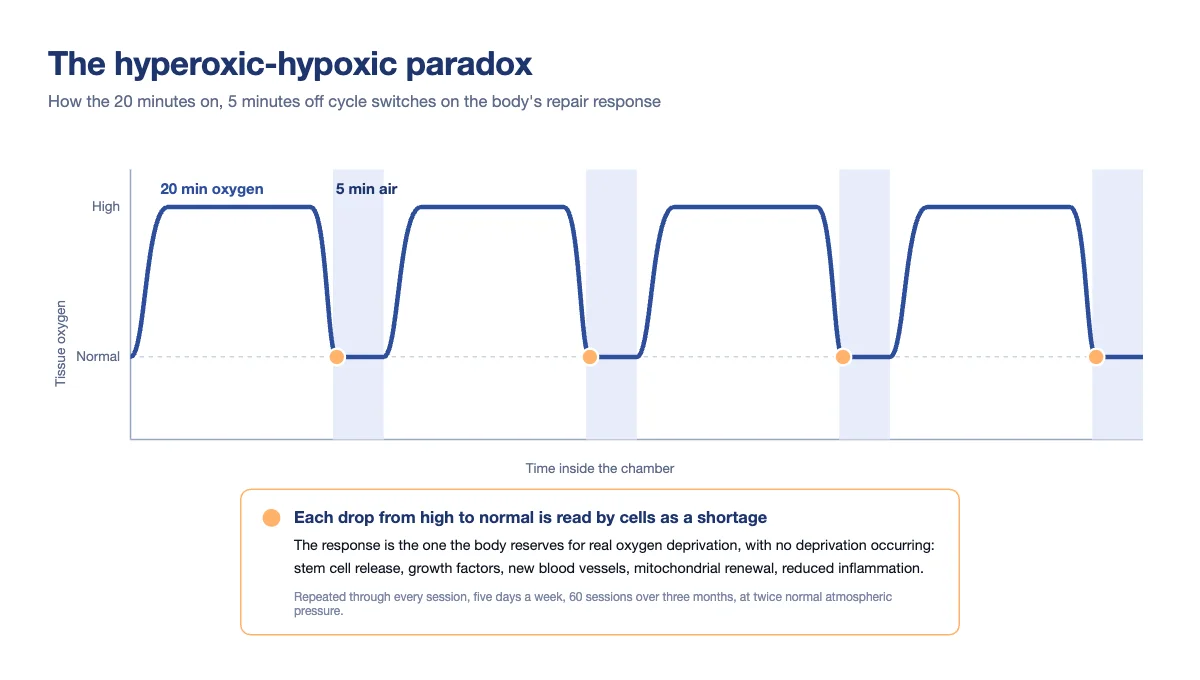
Our neurological and performance protocol runs at twice normal atmospheric pressure (2ATA), in cycles of 20 minutes on oxygen and five minutes on chamber air, for two hours a session, five sessions a week, for a total of 60 sessions over three months, in medical-grade multiplace chambers at our centre in Jumeirah Lakes Towers.
HBOT does not add a signal from outside. It changes the environment inside the body so that your own repair systems switch on. The rise in oxygen delivers far more of it to tissue than breathing at normal pressure can. The repeated drop back to normal oxygen levels during the air breaks is read by cells as a shortage, which triggers the regenerative response the body normally reserves for real oxygen deprivation (hypoxia), without any actual deprivation occurring. This is the hyperoxic-hypoxic paradox, and it is why the protocol is structured as it is.
The measured effects include mobilisation of stem cells from the bone marrow, growth of new blood vessels, improved mitochondrial function, reduced inflammation and, in the brain, increased neuroplasticity and blood flow. These are the same processes peptides are marketed to influence. The difference is that with HBOT they have been measured in humans, in controlled trials, at the pressures and protocol we use.
If you are already using peptides and want a physician’s view on where HBOT fits, you can speak to our clinical team about your current peptide cycle before reading further.
HBOT vs peptides: a side-by-side look
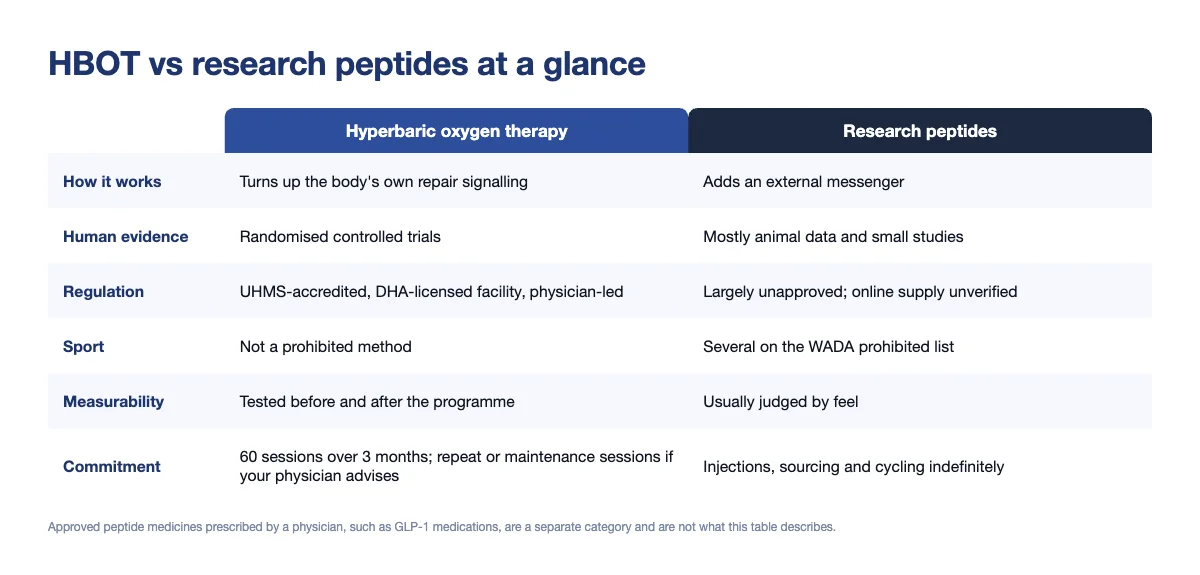
How they work. Peptides introduce an external messenger and depend on the body responding to it. HBOT stimulates the body to produce its own messengers and repair signals. One adds a voice to the conversation; the other turns up the volume on the body’s own.
Evidence. HBOT has randomised controlled trials showing improvement in stroke recovery at the chronic stage, post-concussion syndrome in adults and children, long COVID and cognitive performance in healthy older adults, plus a 2020 study showing changes in biological markers of ageing including telomere length and the clearance of senescent cells. Research peptides have, for the most part, animal data and small or uncontrolled human studies.
Regulation and safety. HBOT is delivered at a UHMS-accredited, DHA-licensed medical facility under physician supervision with a trained attendant in the chamber. Its side effects are well documented and mostly mild: ear pressure during compression, occasional fatigue in the first week, temporary changes in near vision over a long course. Unapproved peptides carry the risks of the compound itself, which are not well characterised, and of the supply chain that produced it.
Sport. HBOT is not a prohibited method in competitive sport. Several of the most popular recovery and performance peptides are.
Measurability. Every client on our programme is tested before and after: cognitive performance, physiological measures and, where relevant, imaging and blood markers. You know whether it worked. With peptides, most people are judging by feel.
Commitment. HBOT requires daily attendance (five times per week) for three months, which for most of our clients means fitting a two-hour session around the working day. Afterwards, the need for further sessions is individual. Some clients repeat the programme, yearly or more often, to stay in peak shape, and some continue with one or two maintenance sessions a week. Your physician will advise based on your results. Peptides require injections, sourcing and, usually, cycling on and off indefinitely.
Cost. A full HBOT programme is a significant investment with a defined course and a measured result, and any repeat programme or maintenance sessions are planned with your physician around those results. Peptide use is an ongoing cost with no natural end and, in the case of unregulated products, no guarantee of what is being paid for.
Where they overlap
The honest picture is that people turn to peptides and to HBOT for the same reasons: healing an injury that has stalled, recovering faster from training, thinking more clearly, sleeping better, having more energy and slowing the biological clock. Both are, in their own way, attempts to get the body to repair itself more effectively.
The question is which route gets you there with evidence, safety and a physician in the room.
A closer look at the most searched peptides
BPC-157. Marketed for tendon, ligament and gut healing. Rodent studies are consistently positive; controlled human trials are essentially absent. The claimed effects, reduced inflammation and accelerated tissue repair, are among the best-documented effects of hyperbaric oxygen in humans, which is the basis of HBOT’s long-established use in wound healing and surgical recovery.
CJC-1295 and ipamorelin. Growth hormone secretagogues, marketed for recovery, sleep and body composition. Early human trials showed increased growth hormone and IGF-1 levels; long-term safety and outcome data do not exist. Prohibited in sport.
GHK-Cu. A copper peptide with a genuine evidence base for topical use in skin. Injectable use for systemic effects is a different claim with a much weaker evidence base.
Epithalon. Marketed for telomere lengthening and longevity. The human data are older and unreplicated. The 2020 HBOT study is, to our knowledge, the first to show telomere lengthening in a prospective human trial of any intervention (except for physical activity, which has shown some effect on telomere length).
GLP-1 medications. The exception. Semaglutide and related medications are approved medicines with large trials behind them. Used under medical supervision as part of a structured programme, they are effective. Used without one, or stopped abruptly, they are not.
Choosing between them
If a physician has prescribed an approved peptide medication for a diagnosed condition, for example a GLP-1 medication as part of a supervised weight management programme, that is medicine, and it belongs in your treatment plan. Our metabolic weight loss programme is built around exactly that kind of supervised care, with dietitian and physician oversight.
If you are considering research peptides for recovery, performance, cognition or ageing, our view is that hyperbaric oxygen therapy achieves the same goals with a stronger evidence base, proper medical oversight and measurable outcomes, and without the regulatory and supply risks. Our peak performance and reverse ageing programmes are designed for precisely these goals.
And if you have already used peptides and are now stopping, there is a specific role for HBOT in that transition, which we cover in a separate article on coming off peptides.
What this looks like in Dubai
Dubai is a city where people work long hours, travel constantly and take their health seriously, and it is also a city where unregulated products are easy to find and easy to be sold. Our centre sits in the middle of that. Clients come to us from DIFC, Dubai Marina, Jumeirah and Abu Dhabi, many of them having already tried something bought online.
The centre is a UHMS-accredited facility, the first in the Middle East (and the third outside the USA), licensed by the Dubai Health Authority, and has delivered tens of thousands of hyperbaric treatments to adults and children. It is a short walk from DMCC Metro station in JLT.
See the evidence for yourself
The best way to compare is to come in. A consultation at our centre includes a conversation with a physician, a tour of the chambers and the assessment facilities, and an honest view on whether HBOT is right for what you are trying to achieve. If it is not, we will say so.
Book a consultation and see the chambers before you decide anything, or call 800-2848 from within the UAE.
Frequently asked questions
Is HBOT better than peptides?
For recovery, performance, cognition and healthy ageing, HBOT has substantially stronger human evidence, is medically supervised and is measurable. For specific approved medicines, such as GLP-1 medications for diabetes or weight management, a peptide prescribed by a physician is the appropriate treatment and HBOT is not a substitute.
Can HBOT and peptides be combined?
Some clients arrive using peptides. Disclose everything you are taking at your consultation so your physician can advise. HBOT has no known interaction with approved peptide medications, but unapproved products are an unknown.
Are peptides legal in the UAE?
Approved peptide medicines prescribed by a licensed physician are legal. Many products sold online as research peptides are not approved for human use in the UAE. Check with a physician before using anything.
Does HBOT do what BPC-157 is supposed to do?
BPC-157 is marketed for tissue healing and reduced inflammation. Those are documented effects of hyperbaric oxygen therapy in human studies, which is why we say the coincidence in the name is a happy one.
How much does a programme cost compared with peptides?
It depends on your programme. A consultation gives you an exact figure.
Is HBOT allowed for athletes competing in the UAE?
Yes. Hyperbaric oxygen therapy is not a prohibited method under the World Anti-Doping Code.